Dubai Creek Lights Project: Dh80 Million to Illuminate Eight Kilometres by Q1 2027
Dubai Creek Lights project announced August 5, 2026 — an Dh80 million Sheikh Hamdan-directed initiative that will illuminate 8 kilometres of historic Dubai Creek using 5,000+ lighting units across six heritage zones by Q1 2027.
Dubai Creek Lights project has been officially launched — an Dh80 million initiative backed by Sheikh Hamdan bin Mohammed bin Rashid Al Maktoum, Crown Prince of Dubai, that will transform the city’s historic eight-kilometre waterfront into an immersive nighttime destination using more than 5,000 lighting units across six key locations.
The Dubai Creek Lights project is expected to be completed in the first quarter of 2027 and will create a striking night-time skyline visible from more than 1,500 feet above ground — turning the waterway that gave birth to Dubai’s trading economy into one of the emirate’s most visually dramatic evening attractions.
Six Locations, 5,000+ Lights, Eight Kilometres of History
The Dubai Creek Lights project covers six distinct zones along the Creek, each receiving a customised lighting design that reflects its unique historical and architectural character.
Creek Quay — the main waterfront promenade area at the heart of historic Deira.
Creek Promenade at the Gold Souq — one of Dubai’s most famous shopping districts, where the lighting will extend the Gold Souq’s golden atmosphere into the evening hours.
Creek entrance at Infinity Bridge — the pedestrian cable-stayed bridge connecting Deira and Bur Dubai sides of the Creek, which will become a major visual anchor of the lighting scheme.
Al Shindagha Historic District — Dubai’s oldest neighbourhood and the location of the Sheikh Saeed Al Maktoum House museum, the Heritage House, and the Al Fahidi district. The lighting here carries the heaviest heritage responsibility — preserving the character of one of the UAE’s most important historical sites while enhancing its evening appeal.
Bur Dubai Souq — the textile, clothing, and household goods market that remains one of Dubai’s most active traditional commercial areas.
Under the directives of Hamdan bin Mohammed, Dubai Municipality begins implementing the Dubai Creek Lights project. With an investment of AED80 million, the project will create an integrated visual and urban experience extending across 8 kilometres of Dubai Creek. Featuring more… pic.twitter.com/3xVTMa4rHV
— Dubai Media Office (@DXBMediaOffice) August 5, 2026
Al Seef Marina — the recently developed heritage-inspired waterfront development that blends traditional dhow architecture with contemporary retail and dining, already a popular evening destination.
Together, these six locations span the complete historic Creek corridor — from Al Shindagha at the Creek mouth to Al Seef to the south — creating a continuous illuminated waterfront experience across one of the world’s most historically significant urban waterfronts.
| Dubai Creek Lights Project — Key Facts | Details |
|---|---|
| Total investment | Dh80 million (~₹193 crore) |
| Total length illuminated | 8 kilometres of Dubai Creek |
| Lighting units | More than 5,000 |
| Visibility | More than 1,500 feet above ground |
| Six key locations | Creek Quay, Gold Souq Promenade, Infinity Bridge, Al Shindagha, Bur Dubai Souq, Al Seef Marina |
| Completion target | Q1 2027 |
| Directive | Sheikh Hamdan bin Mohammed bin Rashid Al Maktoum |
| Implementing authority | Dubai Municipality — Public Facilities Agency |
| Design principle | Customised per location — heritage preserved |
| Sustainability | Minimises marine life impact |
What Officials Said: Heritage, Safety and Sustainability
Eng. Marwan Ahmed bin Ghalita, Director General of Dubai Municipality, framed the Dubai Creek Lights project in explicitly historical terms. Dubai Creek has played a defining role in the emirate’s growth for generations. The Creek served as the city’s main gateway for trade and commerce and witnessed many of the milestones that shaped modern Dubai. The new project will celebrate that legacy by creating a distinctive nighttime experience that connects residents and visitors with the city’s history.
Bader Anwahi, CEO of the Public Facilities Agency at Dubai Municipality, said the project would turn Dubai Creek into a landmark evening destination where architecture, history and culture come together. He said advanced lighting technologies would be carefully adapted to suit the architectural and heritage features of each location, ensuring the area’s character is preserved while enhancing its visual appeal.
The preservation emphasis is deliberate and important. Dubai Creek’s historic districts — Al Fahidi, Al Shindagha, and the old Bur Dubai Souq — are among the UAE’s most carefully protected heritage precincts. Any lighting intervention at these locations requires sensitivity to the wind tower architecture, traditional courtyard buildings, and narrow alley networks that define the area’s character. The Dubai Creek Lights project has committed to this through location-specific design rather than a uniform lighting solution applied across all six zones.
The sustainability commitment addresses a specific concern relevant to the Creek’s ecology. Dubai Creek supports a diverse marine ecosystem including mangrove birds, flamingos, and marine life in the protected areas near the Creek mouth. The lighting system has been designed to minimise its impact on marine life while enhancing the area’s appearance after dark.
The project also includes upgrades to promenade lighting, waterfront walkways, Creek entrances, and building façades — infrastructure improvements that improve pedestrian safety alongside the aesthetic experience.
The Context: Dubai 2040 and Quality of Life 2033
The Dubai Creek Lights project is not a standalone beautification exercise. It connects explicitly to two major Dubai strategic frameworks.
The project supports the goals of the Dubai 2040 Urban Master Plan and the Dubai Quality of Life Strategy 2033, which aim to create more attractive and people-friendly public spaces across the city.
The Dubai 2040 Urban Master Plan — unveiled by Sheikh Mohammed bin Rashid Al Maktoum in 2021 — envisions five urban centres connected by a continuous network of green and blue public spaces. Dubai Creek is one of the plan’s central natural corridors, and the commitment to enhance it as a nighttime destination aligns with the plan’s goal of making Dubai’s public spaces as vibrant and liveable as its private real estate.
The Quality of Life Strategy 2033 targets specific improvements in how Dubai residents experience their city — more walkable districts, more evening activity, more public cultural experiences. Illuminating eight kilometres of the Creek directly advances all three of these goals.
The Dhow Heritage Connection
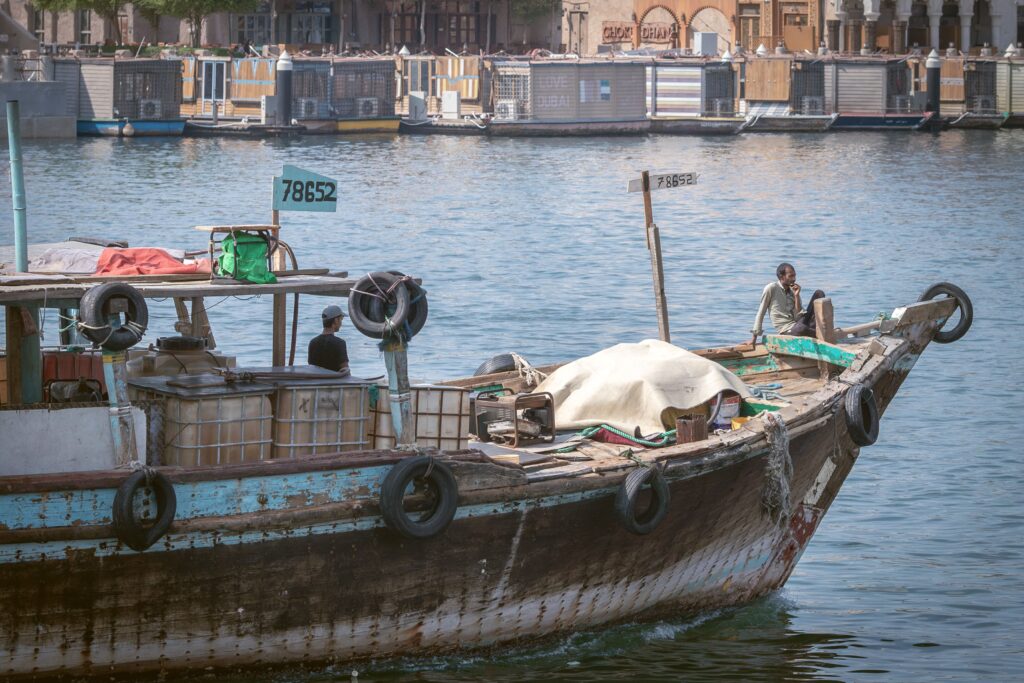
For decades, traditional wooden dhows and trading vessels relied on lights along the Creek to guide them as they carried goods that helped build Dubai’s economy.
The Dubai Creek Lights project pays tribute to that history by giving light a new purpose. Instead of guiding ships, it will create memorable experiences for residents and tourists, encourage evening visits and support businesses along the waterfront.
The dhow heritage is not merely nostalgic framing. Traditional dhows continue to operate on Dubai Creek today — as water taxis crossing between Deira and Bur Dubai, as dinner cruise vessels, and as working cargo dhows loading goods for East Africa, India, and Iran. The Creek is genuinely active, not museumified. The lighting project will illuminate a working waterway, not a heritage theme park.
What This Means for Indian Travelers and Indian Expats in Dubai
Dubai Creek is, in every practical sense, Dubai’s most Indian neighbourhood. The Meena Bazaar clothing district, the Spice Souq, the Gold Souq, and the textile wholesale market at Bur Dubai Souq are all within the project’s six-location zone. The Deira and Bur Dubai areas have the highest concentration of Indian businesses, Indian restaurants, and Indian expatriate community in the UAE.
For the approximately 3.5 million Indian nationals living in the UAE — many of them in Deira, Bur Dubai, and neighbouring Al Qusais — the Dubai Creek Lights project transforms a neighbourhood they already use daily into an international-grade evening destination. Evening walks along the Creek Promenade, dinner in Al Seef, a dhow cruise, and shopping at the Gold Souq at night will all benefit from the illuminated waterfront.
For Indian tourists visiting Dubai specifically to experience the historic, non-Burj Khalifa side of the city — the spice markets, the dhow wharfs, the old textile district — the Q1 2027 completion adds a genuinely new evening itinerary that doesn’t exist today.
Remember UPI does not work in the UAE — carry UAE Dirhams or use a zero-forex international card for the Spice Souq, Gold Souq, and any waterfront dining. For travel insurance covering your UAE and Dubai trips, SafetyWing Nomad Insurance provides comprehensive coverage at affordable daily rates for Indian travelers.
FAQs — Dubai Creek Lights Project 2026
Q: What is the Dubai Creek Lights project and when will it be ready?
The Dubai Creek Lights project is an Dh80 million initiative launched under the directives of Sheikh Hamdan bin Mohammed bin Rashid Al Maktoum that will illuminate eight kilometres of Dubai Creek using more than 5,000 lighting units across six key locations — Creek Quay, Gold Souq Promenade, Infinity Bridge, Al Shindagha Historic District, Bur Dubai Souq, and Al Seef Marina. The project is expected to be completed in the first quarter of 2027. The lighting will be visible from more than 1,500 feet above ground, creating a new Dubai Creek nighttime skyline.
Q: How does the Dubai Creek Lights project preserve heritage character?
The Dubai Creek Lights project has been designed with location-specific customised lighting for each of the six zones — rather than a uniform system applied across all areas. Advanced lighting technologies are carefully adapted to suit the architectural and heritage features of each location, particularly in the sensitive Al Shindagha Historic District and Bur Dubai Souq where traditional wind tower architecture and narrow alley networks require sensitivity. The project also minimises its impact on marine life in the Creek’s ecosystem.
Q: What strategic plan is the Dubai Creek Lights project part of?
The project supports the Dubai 2040 Urban Master Plan — which envisions Dubai Creek as a central natural and public space corridor connecting the city’s five planned urban centres — and the Dubai Quality of Life Strategy 2033, which targets more walkable, evening-active, and people-friendly public spaces. Dubai Municipality is the implementing authority through its Public Facilities Agency.
Final Word
The Dubai Creek Lights project announced August 5, 2026 — Dh80 million, 8 kilometres, 5,000 lighting units, six historic zones, Q1 2027 delivery — is one of the most commercially and culturally significant public space investments Dubai has made in its historic core since the opening of Al Seef.
For Indian tourists and expats who know Dubai Creek as the city’s most familiar neighbourhood — the spice markets, the Gold Souq, the dhow wharfs, the textile bazaar — this lighting project transforms an already beloved destination into an international-grade evening experience. Add it to your Q1 2027 Dubai itinerary now.
Also Read:
- Dubai Smartest City 2026 — BCG Ranks It 2nd, Beats New York
- Ras Al Khaimah Tourism 2026 — Record 670,000 H1 Visitors
- SafetyWing Nomad Insurance — Full Review for Indians
Official Sources:
 Thailand DTV Embassy Rules 2026: Residency Requirement Varies by Mission — Check Before Applying
Thai Airways Winter Schedule 2026: 66 Routes, New Danang, Europe Flights From October 25
Bangkok Airport Taxi Indians 2026: 2,000 Baht Scam Warning and How to Pay the Right Price
Air Astana Dubai 2026: Almaty and Astana Flights Resume October 1–2, 22 Weekly by Month-End
Thailand DTV Embassy Rules 2026: Residency Requirement Varies by Mission — Check Before Applying
Thai Airways Winter Schedule 2026: 66 Routes, New Danang, Europe Flights From October 25
Bangkok Airport Taxi Indians 2026: 2,000 Baht Scam Warning and How to Pay the Right Price
Air Astana Dubai 2026: Almaty and Astana Flights Resume October 1–2, 22 Weekly by Month-End

Aaseem Bhardwaj is a journalist, seasoned traveler and IT professional based in India. With firsthand travel experience across Southeast Asia, East Asia, Middle East and Europe, Aaseem founded Travel Man Today to provide reliable visa updates and travel news for Indian passport holders. He has personally traveled to Thailand, Vietnam, Malaysia, Japan, Singapore, Hong Kong, South Korea, UAE and Europe. Follow his travel vlogs on YouTube at @travelmantoday





Templates for Indians