Wat Paknam Bangkok Guide: Visit Bangkok’s Giant 69m Copper Buddha
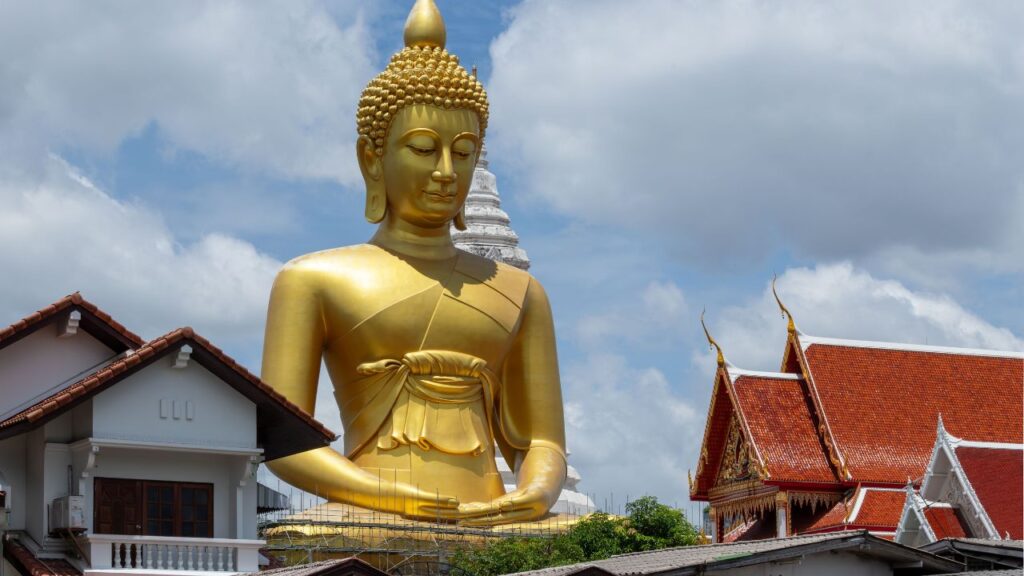
Wat Paknam Bangkok guide — the Phra Buddha Dhammakaya Thep Mongkol rises 69 metres above Wat Paknam Bhasicharoen in Phasi Charoen district, Bangkok's largest Buddha statue and the first giant Buddha in the world cast entirely from 99.99% pure copper, completed in 2019.
Quick answer: Wat Paknam Bhasicharoen houses Bangkok’s largest Buddha statue — the 69-metre Phra Buddha Dhammakaya Thep Mongkol, cast from 99.99% pure copper, completed in 2019. Entry is free. The temple is in Phasi Charoen district, approximately 30 minutes from central Bangkok by MRT and taxi. Open daily.
Wat Paknam Bangkok guide — Bangkok’s most underrated monumental temple experience is not on the Grand Palace road and not listed in most standard Bangkok tourist itineraries. The Phra Buddha Dhammakaya Thep Mongkol at Wat Paknam Bhasicharoen is Bangkok’s largest Buddha statue and the third-tallest statue in all of Thailand — a 69-metre meditation-posture Buddha cast entirely from 99.99% pure copper, the first giant Buddha statue in the world built from this material.
For Indian travelers who have seen Wat Phra Kaew, Wat Arun, and Wat Pho on previous Bangkok visits, Wat Paknam Bangkok guide reveals a completely different scale of Buddhist devotion — one that towers over Bangkok’s western canal districts the way no other structure in the city does. See our Wat Pho Bangkok guide for the classic Bangkok temple comparison.
The Statue: 69 Metres, 99.99% Pure Copper, Facing North
The Phra Buddha Dhammakaya Thep Mongkol — the full name of the Wat Paknam giant Buddha — is both the largest Buddha statue in Bangkok and the third-tallest statue in Thailand. Its dimensions are extraordinary even by the standards of Southeast Asia’s tradition of monumental religious architecture.
The statue measures 69 metres from its base to the top of its head — taller than a 20-storey building — with a lap span of 40 metres. It faces north, which in Thai Buddhist tradition is the direction associated with death and rebirth — a specific orientation chosen by the abbot who initiated the project rather than an incidental compass heading.
The statue was cast from 99.99% pure copper — a material choice that is unique among the world’s giant Buddha statues. Most large Buddha statues are cast from bronze, built from reinforced concrete with decorative coating, or plated with gold leaf. The Wat Paknam statue’s solid copper construction — requiring the development of specialised casting techniques to achieve the scale — makes it the first of its kind in the world according to the temple’s records.
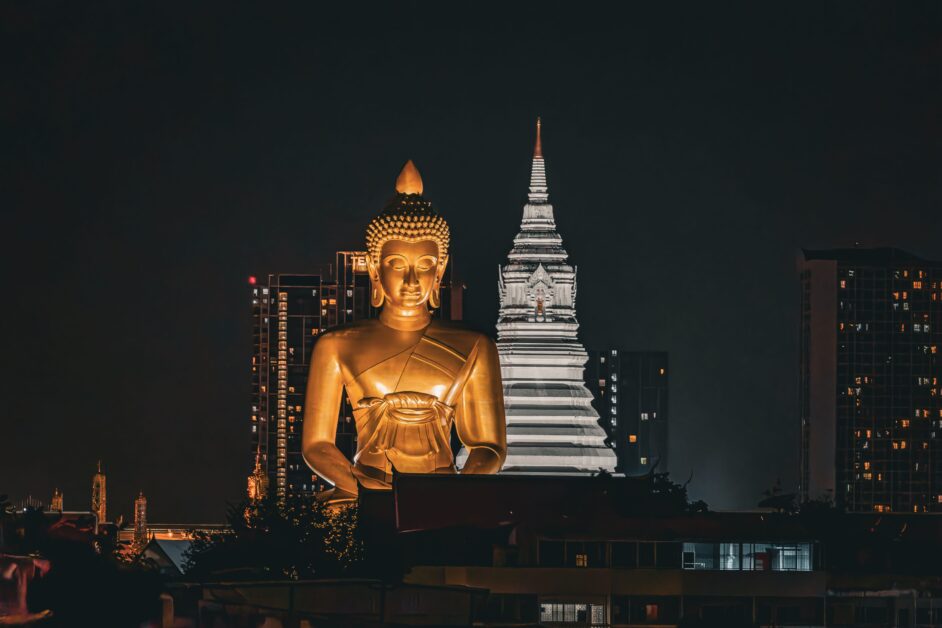
The visual effect of 99.99% copper against Bangkok’s sky changes with the light. In early morning, the statue has a warm reddish-brown tone that deepens in direct sunlight. In overcast conditions — common during Bangkok’s monsoon season — the copper takes on a more muted, almost archaeological quality. In evening light, the surface catches the last horizontal sun with an effect that no gold-plated statue can replicate.
The History: Initiated 2016, Completed 2019
The Wat Paknam Bangkok guide story begins in 2016 when Somdet Phra Maha Ratchamangkalachan, the ninth abbot of Wat Paknam, initiated the construction as an offering to the Buddha, the Dhamma and the Sangha — the Three Jewels of Buddhism — and as a royal merit-making dedication to members of the Thai royal family.
Construction began on March 4, 2017, and was completed in 2019. The statue was named Phra Buddha Dhammakaya Thep Mongkol by Somdet Phra Maha Ratchamangkalachan himself — a name that connects it to the Dhammakaya meditation movement, which traces its origins to Wat Paknam Bhasicharoen. The Dhammakaya tradition is one of Thailand’s most influential modern Buddhist movements, and Wat Paknam is its historic founding temple.
For Indian Buddhist travelers, the Dhammakaya connection has particular cultural resonance. The Dhammakaya meditation technique — a visualisation-based practice centred on an internal crystal sphere or Buddha image — has documented connections to ancient Indian meditation traditions and has attracted Indian practitioners through its global centres. Visiting Wat Paknam is not merely sightseeing but a connection to a living Buddhist tradition with Indian roots.
The Temple: Beyond the Giant Buddha
The Wat Paknam Bangkok guide is not only about the giant copper statue — Wat Paknam Bhasicharoen is one of Bangkok’s major temple complexes with multiple structures of religious and artistic significance.
The main ubosot (ordination hall) is an older structure predating the copper Buddha by decades, with traditional Thai temple architecture including gilded spires, naga (serpent) balustrades, and intricate roof finals. The main Buddha image inside the ubosot is the historic focus of devotion at Wat Paknam.
The stupa (chedi) complex includes a large white-and-gold stupa that houses relics and is circumambulated by worshippers on Buddhist holy days. The stupa is approximately 80 metres tall — comparable in scale to the copper Buddha statue nearby.
The Dhammakaya meditation hall is a purpose-built large hall where practitioners of the Dhammakaya meditation technique participate in group sessions. Morning sessions typically begin at 7am.
The riverside location. Wat Paknam sits beside one of Bangkok’s historic canals — the same Bangkok Noi-Bangkok Yai canal system that the Royal Barge Procession uses. The temple’s canal-side location makes it accessible by longtail boat from the Chao Phraya River system, in addition to road and MRT access.
| Wat Paknam Bangkok Guide — Key Visitor Facts | Details |
|---|---|
| Full name | Wat Paknam Bhasicharoen |
| District | Phasi Charoen, Bangkok (Thonburi side) |
| Statue name | Phra Buddha Dhammakaya Thep Mongkol |
| Statue height | 69 metres (base to head) |
| Lap span | 40 metres |
| Facing direction | North |
| Material | 99.99% pure copper — first of its kind globally |
| Construction | Began March 4, 2017 — completed 2019 |
| Entry fee | Free |
| Opening hours | Daily — check current hours before visiting |
| Dress code | Modest — shoulders and knees covered |
| Nearest MRT | Bang Pho (Blue Line) — then taxi/Grab approximately 15 minutes |
| Distance from Grand Palace | Approximately 7–8 km via Chao Phraya and canal route |
How to Get to Wat Paknam from Central Bangkok
The Wat Paknam Bangkok guide routing depends on where in Bangkok you are staying.
From Sukhumvit or Silom (BTS areas): Take the BTS to Saphan Taksin, then the Chao Phraya Express Boat northward to Tha Maharaj or Phra Chan pier, then a Grab car west across the river to Wat Paknam. Total journey approximately 45–55 minutes. Alternatively, a direct Grab from most Sukhumvit hotels takes 25–35 minutes depending on traffic.
From the MRT Blue Line: Bang Pho station on the MRT Blue Line extension is the closest metro station to Wat Paknam — approximately 12–15 minutes by Grab or motorcycle taxi from the station. The MRT Blue Line extension connects at Hua Lamphong to the main Bangkok MRT network.
By river and canal: From the Chao Phraya River, longtail boats enter the Bangkok Noi and Bangkok Yai canal system — tell the boat operator “Wat Paknam Bhasicharoen.” This is the most atmospheric approach but requires some familiarity with Bangkok’s water taxi network.
Important: Wat Paknam is on the Thonburi side of the Chao Phraya River — the west bank, across from Bangkok’s traditional tourist corridor. Plan extra crossing time if combining with Grand Palace or Wat Pho on the same day.
What Indian Travelers Need to Know About Temple Etiquette
The Wat Paknam Bangkok guide includes specific etiquette considerations that Indian visitors should follow. Thai Buddhist temple protocol is stricter than what most Indian Hindu temple visitors are accustomed to.
Dress code is strictly enforced. Both men and women must cover shoulders and knees. Singlets, sleeveless tops, shorts, and miniskirts are not permitted inside any Thai temple — and enforcement at Wat Paknam, a major active temple rather than a tourist attraction, is genuine. Sarongs for rent are typically available at temple gates for visitors who arrive without appropriate attire.
Shoes off inside all buildings. Remove shoes before entering any temple building or ordination hall. Socks are fine. The copper Buddha statue’s platform may also require shoe removal — follow the signs and the behaviour of Thai worshippers.
Photography respectfully. Photography of the Buddha statue and temple grounds is generally permitted. Do not climb on sacred structures, pose irreverently near Buddha images, or photograph active prayers without discretion.
Monday–Friday morning visits. The Dhammakaya meditation sessions and regular morning merit-making activities peak on Buddhist holy days (wan phra — the lunar calendar sabbath days). Weekday mornings offer a more intimate temple experience with genuine devotional activity rather than tourist crowds.
Before any Bangkok trip, confirm current Thailand entry requirements at thaievisa.go.th. India’s 30-day visa-free entry approved July 14 awaits Royal Gazette publication. Complete the mandatory TDAC at tdac.immigration.go.th within 72 hours before departure. UPI does not work in Thailand — carry Thai Baht or a zero-forex card. For travel insurance covering Thailand trips, SafetyWing Nomad Insurance provides comprehensive coverage at affordable daily rates for Indian travelers.
FAQs — Wat Paknam Bangkok Guide 2026
Q: How tall is the Wat Paknam giant Buddha and what is it made from?
The Phra Buddha Dhammakaya Thep Mongkol at Wat Paknam Bhasicharoen measures 69 metres from its base to the top of its head — Bangkok’s largest Buddha statue and the third-tallest statue in Thailand. Its lap spans 40 metres. The entire statue was cast from 99.99% pure copper, making it the first giant Buddha statue in the world to be constructed entirely from this material according to the temple. Construction began March 4, 2017 and was completed in 2019.
Q: Is there an entry fee for Wat Paknam Bhasicharoen?
Entry to Wat Paknam Bhasicharoen is free. The temple is an active place of Buddhist worship rather than a ticketed tourist attraction — donations to the temple are welcomed but not required. Dress modestly with shoulders and knees covered, remove shoes inside temple buildings, and follow the behaviour of Thai worshippers for respectful conduct within the temple grounds.
Q: How do I get to Wat Paknam from central Bangkok?
From Sukhumvit or Silom areas, a direct Grab car to Wat Paknam Bhasicharoen takes approximately 25–35 minutes depending on traffic. Alternatively, take BTS to Saphan Taksin, then the Chao Phraya Express Boat, then a Grab across the river. The nearest MRT station is Bang Pho on the Blue Line extension — approximately 12–15 minutes by Grab from the station. Wat Paknam is on the Thonburi (west bank) side of the Chao Phraya River.
Final Word
The Wat Paknam Bangkok guide reveals one of the city’s most visually extraordinary and spiritually significant sites — a 69-metre pure copper meditation Buddha that towers above the canal districts of Bangkok’s west bank with a scale and material uniqueness that no other Bangkok temple can match.
For Indian Buddhist travelers specifically, Wat Paknam’s connection to the Dhammakaya meditation tradition and its living devotional community make it a more meaningful visit than some of Bangkok’s better-known but more touristy temple sites. It takes 35 minutes to reach by Grab from most Bangkok hotels, costs nothing to enter, and rewards any traveler who makes the detour from the standard Wat Pho–Grand Palace–Wat Arun circuit with an experience they are unlikely to have seen on anyone else’s Bangkok Instagram feed.
Also Read:
- Wat Pho Bangkok Guide 2026 — THB 300 Entry, Massage, Ramakien
- Bangkok Nightlife Safety 2026 — BMA Inspects 1,100 Venues
- Thailand Travel Advisory Indians — Full Entry and Safety Guide
Official Sources:
- Khaosod English — Discover the Giant Buddha at Bangkok’s Wat Paknam
- Wat Paknam Bhasicharoen Official
 Thailand Itinerary Indians 5 Days: Bangkok, Ayutthaya, Chiang Mai — ₹31,250 Cost Breakdown
Trusted Thailand 2026: What the Safety Certification Means for Indian Travelers
UAE Flights Disruption 2026: SpiceJet India Routes Delayed, Air Canada Suspends to March 2027
EU Hand Luggage Rules 2026: What Actually Changed — and What Hasn’t Yet
Thailand Itinerary Indians 5 Days: Bangkok, Ayutthaya, Chiang Mai — ₹31,250 Cost Breakdown
Trusted Thailand 2026: What the Safety Certification Means for Indian Travelers
UAE Flights Disruption 2026: SpiceJet India Routes Delayed, Air Canada Suspends to March 2027
EU Hand Luggage Rules 2026: What Actually Changed — and What Hasn’t Yet

Aaseem Bhardwaj is a journalist, seasoned traveler and IT professional based in India. With firsthand travel experience across Southeast Asia, East Asia, Middle East and Europe, Aaseem founded Travel Man Today to provide reliable visa updates and travel news for Indian passport holders. He has personally traveled to Thailand, Vietnam, Malaysia, Japan, Singapore, Hong Kong, South Korea, UAE and Europe. Follow his travel vlogs on YouTube at @travelmantoday



Templates for Indians