Thailand Drone Rules Indians Must Know: CAAT 2026 Registration and Border Restrictions
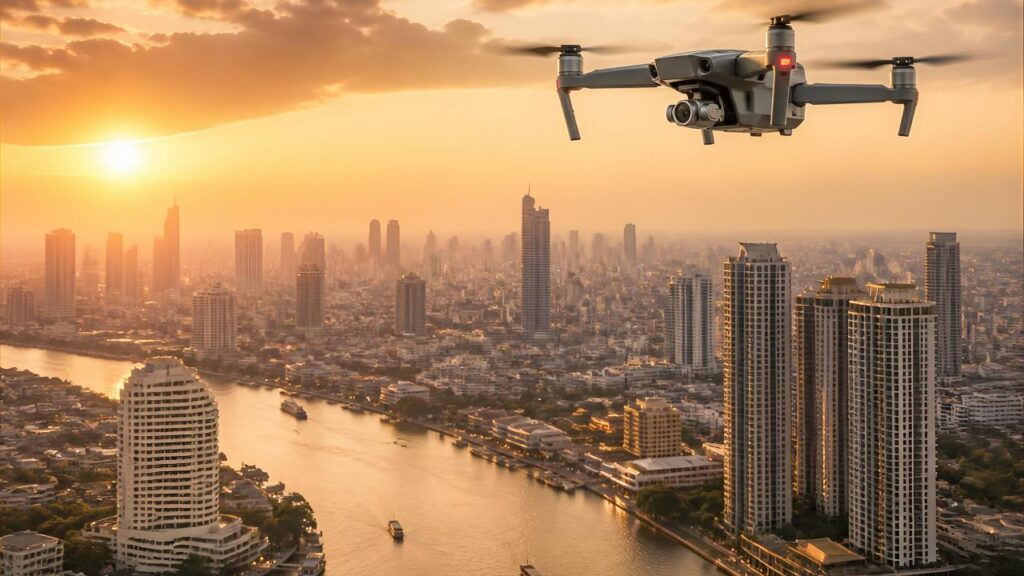
Thailand drone rules Indians must follow updated June 26, 2026 under CAAT Notice No. 16 — registration with both NBTC and CAAT required, three-day pre-flight UAS Portal approval mandatory, with restricted districts across seven border provinces.
Thailand drone rules Indians planning to carry a drone on their trip must understand have been significantly updated in June 2026 — most destinations across Thailand are open for drone flights provided operators complete registration and comply with CAAT regulations, but seven border provinces have newly defined restricted districts where recreational drone flights remain prohibited without special authorisation.
The Civil Aviation Authority of Thailand issued CAAT Notice No. 16 on June 26, 2026, which came into effect immediately and further relaxes special drone restrictions following assessment with national security agencies related to the Thai–Cambodian border situation. For Indian drone photographers visiting Bangkok, Chiang Mai, Phuket, Chiang Rai, or the Gulf Coast islands, the updated Thailand drone rules Indians need to follow are manageable — but registration, insurance, and pre-flight approvals are non-negotiable requirements, not optional formalities.
The Seven Restricted Border Provinces: Full District List
The Thailand drone rules Indians must be aware of include a comprehensive list of controlled districts in seven eastern and northeastern border provinces where recreational and tourism-related drone flights remain restricted under CAAT Notice No. 16.
In these controlled districts, recreational or tourism-related drone flights are not generally permitted unless specifically authorised by CAAT and the relevant area owner or responsible agency.
Ubon Ratchathani: Khemarat, Na Tan, Pho Sai, Si Mueang Mai, Khong Chiam, Sirindhorn, Buntharik, Na Chaluai, and Nam Yuen Districts.
Si Sa Ket: Phu Sing, Khun Han, and Kantharalak Districts.
Surin: Phanom Dong Rak, Kap Choeng, Sangkha, and Buat Chet Districts.
Buri Ram: Lahan Sai and Ban Kruat Districts.
Sa Kaeo: Khlong Hat, Aranyaprathet, Khok Sung, and Ta Phraya Districts.
Chanthaburi: Mueang Chanthaburi, Soi Dao, and Pong Nam Ron Districts.
Trat: Mueang Trat, Khlong Yai, and Bo Rai Districts.
Indian travelers heading to popular Chanthaburi and Trat destinations — including the Trat islands such as Koh Chang, Koh Kood, and Koh Mak — should note that Mueang Trat and surrounding districts are specifically listed in the restricted zone. Confirm current status with CAAT before flying in any of these districts.
| Thailand Drone Rules Indians — Restricted Province Summary | Restricted Districts |
|---|---|
| Ubon Ratchathani | 9 districts — Khemarat, Na Tan, Pho Sai, Si Mueang Mai, Khong Chiam, Sirindhorn, Buntharik, Na Chaluai, Nam Yuen |
| Si Sa Ket | 3 districts — Phu Sing, Khun Han, Kantharalak |
| Surin | 4 districts — Phanom Dong Rak, Kap Choeng, Sangkha, Buat Chet |
| Buri Ram | 2 districts — Lahan Sai, Ban Kruat |
| Sa Kaeo | 4 districts — Khlong Hat, Aranyaprathet, Khok Sung, Ta Phraya |
| Chanthaburi | 3 districts — Mueang Chanthaburi, Soi Dao, Pong Nam Ron |
| Trat | 3 districts — Mueang Trat, Khlong Yai, Bo Rai |
| All other Thai provinces | Drone flights permitted — registration and approval required |
Step-by-Step: How to Legally Register Your Drone in Thailand
The Thailand drone rules Indians follow require registration with two separate government agencies before any flight — and a single registration alone is legally insufficient.
Agency 1 — NBTC (National Broadcasting and Telecommunications Commission)
The NBTC handles drone ownership and radio frequency registration. Every drone must be registered with NBTC regardless of its weight or whether it has a camera. Complete registration at anyregis.nbtc.go.th.
Agency 2 — CAAT (Civil Aviation Authority of Thailand)
The CAAT handles drone and pilot registration and issues the required drone pilot certificate through the UAS Portal at uasportal.caat.or.th. CAAT registration is additionally required for all drones equipped with cameras or recording devices, all drones weighing over 2 kilograms, and all drones exceeding 25 kilograms (which also require written approval from the Minister of Transport).
The registration process step by step:
Upon arrival in Thailand, you will need a Thai SIM card to initiate registration via the UAS Portal — the verification system uses a one-time password sent to a Thai number. Purchase a tourist SIM at the airport before registering.
Create an account on the UAS Portal, verify your identity through the OTP process, and submit documents for both your drone and yourself as the operator. Complete CAAT’s online knowledge test — the test covers Thai airspace rules and must be passed before a drone pilot certificate is issued. If the exam is not passed, it may be retaken after a 24-hour waiting period. Once approved, the certificate remains valid for two years. A registration number will be issued and must be visibly displayed on the drone using a font size of at least 3mm for drones under 25kg.
Insurance, Pre-Flight Approval, and the 3-Day Rule
Three additional requirements in the Thailand drone rules Indians must plan around before each flight.
Insurance: Drones must be insured with third-party liability coverage of at least one million Thai Baht (~₹2.4 million). Insurance may be arranged locally in Thailand or from abroad before your trip. Many Indian travel insurance policies do not cover drone third-party liability — check your policy specifically and purchase supplemental drone insurance if required before flying.
Pre-flight UAS Portal approval — 3 days minimum: Flight details including the area, date, time, and purpose must be submitted to CAAT at least three days in advance through the UAS Portal at uasportal.caat.or.th. This means you cannot decide to fly your drone on a morning whim — plan your drone shoots at least three days ahead and submit through the portal.
Anti-Drone Centre notification: Before each approved flight, operators must also notify the Anti-Drone Centre, Metropolitan Police Bureau, by email at anti-drone@royalthaipolice.go.th. This is in addition to the CAAT UAS Portal approval — not a replacement.
Flight Rules: What You Can and Cannot Do
The Thailand drone rules Indians follow in the air are governed by CAAT’s safety and airspace guidelines.
Permitted: Flights during daylight hours only. Clear weather conditions only. Within visual line of sight at all times — you must be able to see your drone directly, not only through a camera feed. Minimum altitude maintained from obstacles. Safe distances of 30 metres for drones under 2kg and 50 metres for drones between 2–25kg from people and property.
Prohibited: Flying over urban areas, crowds, or near government buildings, hospitals, military zones, or restricted airspace without authorisation. Flying within 9 kilometres of an airport or temporary airfield without specific CAAT permission. Night flights without prior written CAAT approval (email: uasoperation@caat.or.th). Flights above 90 metres without CAAT approval. Flying into or near cloud cover. Using first-person view camera feed alone as navigation. Transporting hazardous materials including laser devices.
Special operations requiring written approval: Night flights, flights above 90 metres, entry into restricted zones, and any operation in the controlled border districts require advance written approval from CAAT submitted by email.
Penalties: Up to One Year Imprisonment and THB 40,000 Fine
The Thailand drone rules Indians need to take seriously carry substantial penalties. Violations are punishable by imprisonment of up to one year, a fine of up to 40,000 baht (~₹96,000), or both.
Authorised military or security agencies may also take enforcement action against drones that violate the notice, including the use of anti-drone systems where necessary. This is not a theoretical risk in the border district zones — active anti-drone systems operate in restricted areas.
Any drone-related incident must be reported immediately to CAAT at +66 2 568 8851.
Reporting violations: Members of the public — including hotel staff, other tourists, or Thai citizens — can report unlawful drone activity to CAAT (Unmanned Aircraft Standards and Technology Division: +66 2 568 8851), the Anti-Drone Centre Metropolitan Police Bureau (+66 2 126 7846), or the nearest police station.
What Indian Drone Photographers Need to Know
India is one of the world’s most enthusiastic drone-owner markets — and Indian travelers frequently bring DJI Mini 3, DJI Mini 4 Pro, or DJI Air 3 drones on international trips for landscape and travel photography.
The most important practical difference the Thailand drone rules Indians face versus flying at home is the registration timeline. In India, a drone operator registered with DGCA can fly registered drones with reasonable planning flexibility. In Thailand, the mandatory three-day pre-flight approval through the UAS Portal means your drone itinerary must be planned and submitted three days in advance — not on the day.
For Indian travelers planning drone photography at Thailand’s most spectacular locations — the sunrise at Doi Inthanon in Chiang Mai, the Phi Phi Islands as seen from above, the flooded temples of Sangkhlaburi, or the rice terraces of northern Thailand — plan your shots at least a week ahead and submit UAS Portal approvals three days before each planned session.
The Thai SIM card requirement for registration is easily solved — buy a tourist SIM at Suvarnabhumi, Don Mueang, or Phuket Airport on arrival for THB 100–300 (~₹240–720) from AIS, DTAC, or TrueMove, all of which sell prepaid tourist packages at arrival.
Before any Thailand trip, confirm current entry requirements at thaievisa.go.th. Complete the mandatory TDAC digital arrival card within 72 hours before departure. Remember UPI does not work in Thailand — carry Thai Baht or a zero-forex international card. For travel insurance covering Thailand trips including drone third-party liability, SafetyWing Nomad Insurance — verify whether drone liability coverage is included in your specific policy tier.
FAQs — Thailand Drone Rules Indians 2026
Q: Do I need to register my drone before flying in Thailand?
Yes — Thailand drone rules Indians must follow require registration with two separate agencies before any flight. Both the drone and the operator must be registered with the National Broadcasting and Telecommunications Commission (NBTC) at anyregis.nbtc.go.th and the Civil Aviation Authority of Thailand (CAAT) at uasportal.caat.or.th. CAAT registration includes completing an online knowledge test and obtaining a drone pilot certificate valid for two years. A Thai SIM card is required to complete the UAS Portal registration process. Drone flights without proper registration are illegal in Thailand.
Q: Where in Thailand is it illegal to fly a drone?
Under CAAT Notice No. 16 effective June 26, 2026, recreational and tourism-related drone flights are prohibited without special CAAT authorisation in controlled districts across seven border provinces — Ubon Ratchathani (9 districts), Si Sa Ket (3 districts), Surin (4 districts), Buri Ram (2 districts), Sa Kaeo (4 districts), Chanthaburi (3 districts), and Trat (3 districts). Additionally, drone flights are prohibited within 9 kilometres of airports, over crowds and government buildings, and in restricted military zones. All other Thai provinces are open for drone flights subject to registration and pre-flight approval requirements.
Q: How far in advance must I apply for drone flight approval in Thailand?
Flight details including the area, date, time and purpose must be submitted to CAAT at least three days in advance through the UAS Portal at uasportal.caat.or.th. Operators must also notify the Anti-Drone Centre, Metropolitan Police Bureau, by email before each approved flight. Special operations — night flights, flights above 90 metres, and entry into restricted zones — require prior written CAAT approval submitted by email. Drone insurance covering third-party liability of at least one million Thai Baht is mandatory before any flight.
Final Word
The Thailand drone rules Indians must follow in 2026 are comprehensive but navigable — most of Thailand is open for drone photography provided you register, insure, and apply for approval at least three days ahead. The seven border province restricted districts are the main new complexity under CAAT Notice No. 16.
For Indian travelers carrying DJI or other consumer drones for travel photography, the three-day advance approval window is the single most important planning consideration — spontaneous drone flights are not legally possible in Thailand.
Plan your shoot locations, register at the UAS Portal, buy your Thai SIM at the airport, ensure drone liability insurance is in place, and submit approvals three days before each planned session. Follow these steps and your Thailand aerial photography trip proceeds legally and without risk of the THB 40,000 fine or one-year imprisonment penalty.
Also Read:
- Thailand Travel Advisory Indians July 2026 — Full Guide
- India Thailand Visa Waiver — 30 Days Free, Arrivals to Surge
- Thailand E-Visa Indians 2026 — Fees, Types and How to Apply
Official Sources:
 Thailand DTV Embassy Rules 2026: Residency Requirement Varies by Mission — Check Before Applying
Thai Airways Winter Schedule 2026: 66 Routes, New Danang, Europe Flights From October 25
Bangkok Airport Taxi Indians 2026: 2,000 Baht Scam Warning and How to Pay the Right Price
Air Astana Dubai 2026: Almaty and Astana Flights Resume October 1–2, 22 Weekly by Month-End
Thailand DTV Embassy Rules 2026: Residency Requirement Varies by Mission — Check Before Applying
Thai Airways Winter Schedule 2026: 66 Routes, New Danang, Europe Flights From October 25
Bangkok Airport Taxi Indians 2026: 2,000 Baht Scam Warning and How to Pay the Right Price
Air Astana Dubai 2026: Almaty and Astana Flights Resume October 1–2, 22 Weekly by Month-End

Aaseem Bhardwaj is a journalist, seasoned traveler and IT professional based in India. With firsthand travel experience across Southeast Asia, East Asia, Middle East and Europe, Aaseem founded Travel Man Today to provide reliable visa updates and travel news for Indian passport holders. He has personally traveled to Thailand, Vietnam, Malaysia, Japan, Singapore, Hong Kong, South Korea, UAE and Europe. Follow his travel vlogs on YouTube at @travelmantoday



Templates for Indians