Wat Pho Bangkok Guide: Beyond the Reclining Buddha — What Most Visitors Miss
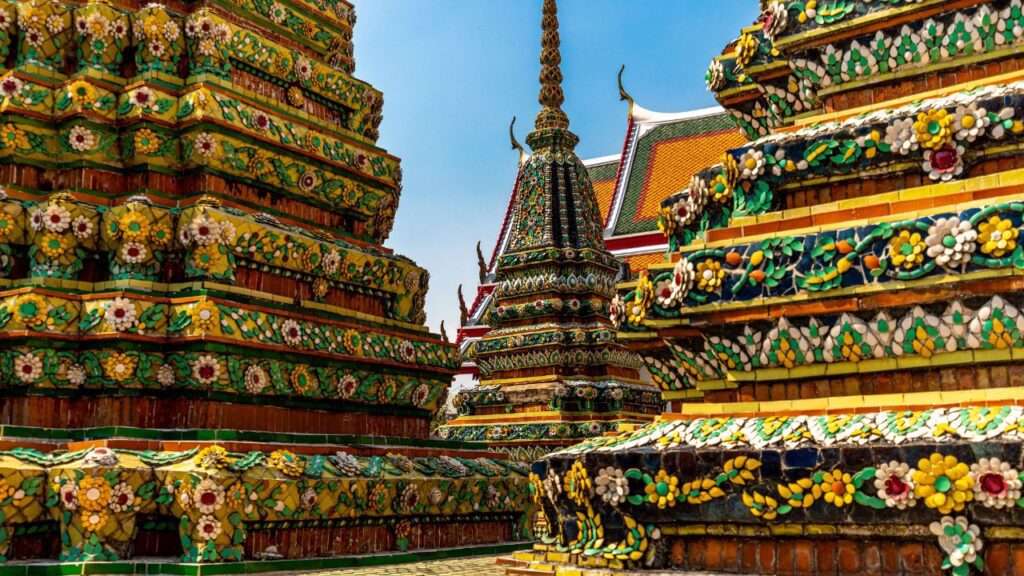
Wat Pho Bangkok guide — Thailand's oldest royal temple, birthplace of Thai massage, and UNESCO Memory of the World encyclopaedia inscribed across 394 stone tablets in the outer cloisters.
Wat Pho Bangkok guide begins with the obvious — the 46-metre gold Reclining Buddha that almost every visitor photographs — but the temple complex founded in the 18th century holds far more than one famous statue. Wat Pho is Thailand’s oldest royal temple, its first public university, the birthplace of traditional Thai massage, a UNESCO Memory of the World archive inscribed in stone, and one of the most architecturally layered religious sites in Southeast Asia.
Most visitors spend 45 minutes at Wat Pho and see perhaps 20 percent of what is actually there. This Wat Pho Bangkok guide covers everything worth knowing — the Reclining Buddha experience itself, the four royal chedis, the 394 stone tablet encyclopaedia, the massage school, practical entry fees and opening hours, and how Indian families specifically should plan the visit.
The Reclining Buddha: How to Experience It Properly
The Reclining Buddha — Phra Phuttha Saiyat — is 46 metres long and 15 metres high, covered in gold leaf, depicting the Buddha in the pose of his final transition to Parinirvana. The hall built to contain it is barely wider than the statue itself, creating an intimate, overwhelming scale experience rather than the panoramic view most visitors expect.
Walk along the right side — the Buddha’s back — to reach the feet, then return along the left side — facing the bowls corridor — to exit.
The feet are the most important detail to pause at. The soles of the Reclining Buddha’s feet are the most photographed element after the full statue — 108 auspicious characteristics of the Buddha depicted in intricate mother-of-pearl inlay panels, covering the entire underside of both feet. Allow time to walk specifically to the foot end and examine the mother-of-pearl work closely. Most visitors take a photo of the statue and exit without ever reaching the feet — missing the most detailed and symbolically significant part of the entire image.
The row of 108 bronze alms bowls along the left wall of the hall is the second element most visitors skip. Buying a bag of coins and placing one coin in each bowl as you walk past is one of Wat Pho’s most traditional merit-making practices. The sound of coins finding their bowls, repeated by dozens of visitors simultaneously, is the defining audio memory of the space.
Thailand’s First Public University: The Stone Tablet Encyclopaedia
This is the element of Wat Pho that most visitors completely miss — and it is arguably the most intellectually significant thing in the entire complex.
Under King Rama III (1824–1851), the temple was transformed into Thailand’s first public university — a repository of knowledge on medicine, astronomy, literature, and history inscribed on stone tablets set into the temple walls — a collection so significant it earned a UNESCO Memory of the World designation.
The outer galleries of Wat Pho showcase 394 stone inscriptions on Ramakien epics and herbal remedies, tucked away from main paths in quiet cloisters.
The tablets were King Rama III’s equivalent of a national library and encyclopaedia — inscribed on stone rather than paper because stone would survive where paper deteriorates in Thailand’s tropical climate. The subjects covered include traditional Thai medicine and pharmacology, Thai massage theory (with anatomical diagrams), astronomy, yoga postures, military strategy, literature, and history. The Ramakien inscriptions — the Thai version of the Hindu epic Ramayana — include scenes from the narrative cycle that Indian visitors will recognise immediately.
For Indian visitors specifically, the Ramakien inscriptions at Wat Pho create a direct connection point. The Thai Ramakien is derived from Valmiki’s Ramayana — Rama, Sita, Hanuman, Ravana, and Lakshmana all appear under their Thai names in the temple’s stone narrative, surrounding a golden temple complex that traces its artistic lineage to the Hindu-Buddhist kingdoms of ancient Java and Khmer.
The Four Royal Chedis: What They Mean
The four towering chedis on the western side of Wat Pho are among Bangkok’s most photographed structures — but most visitors do not know what they represent.
The four chedis honour the first four kings of the Chakri dynasty — Rama I, Rama II, Rama III, and Rama IV — each in a distinct colour. The green mosaic chedi honours Rama I, the white one Rama II, the blue one Rama III, and the yellow one Rama IV. The chedis are covered in Chinese porcelain tile mosaic — a decoration tradition that arrived in Thailand through trade with China, giving the chedis a glittering, botanical texture that changes entirely in different light conditions.
Beyond the four royal chedis, Wat Pho contains 91 smaller chedis throughout the complex — many enclosing the ashes of royal family members and senior monks. Walking through the chedi forest in the northern section of the complex, where several dozen chedis cluster together, is one of the most architecturally extraordinary experiences in Bangkok — and almost no tourists make it there.
The Massage School: Birthplace of Thai Massage
Wat Pho is also the birthplace of traditional Thai massage — massages are available on-site from ฿260 to ฿420 on a walk-in basis.
The Wat Pho Thai Traditional Medicine School has, since 1955, trained over 200,000 experts, making it the best place on earth to get an authentic Thai massage.
The massage pavilions at Wat Pho are the original institutional context for the art that is now practised across thousands of spas, parlours, and street-front shops throughout Thailand. The therapists here are trained in the traditional nuad boran style that corresponds to the anatomical massage theory inscribed on the temple’s stone tablets — the same tradition codified by King Rama III’s encyclopaedic project.
For Indian visitors who practise yoga or are familiar with Ayurvedic massage traditions, the theoretical framework of nuad boran has meaningful parallels with Indian bodywork traditions — both working on the body’s energy lines (called sen in Thai, similar to the nadi concept in yoga) and using sustained pressure to release tension patterns.
A 30-minute foot massage at Wat Pho costs THB 260 (~₹630). A 1-hour traditional Thai massage costs THB 420 (~₹1,020). Book at the on-site reception when you enter — massages are available on a first-come, first-served walk-in basis but can fill up during peak morning hours.
Practical Visitor Information 2026
Entry costs ฿300 per person. The temple is open daily from 8am to 7:30pm.
The best time to visit Wat Pho is early morning from 8am to 10am, when temperatures are cooler, crowds are smaller, and the light is soft and ideal for photography. Late afternoon from 4pm to 6pm is also a good option for a more mellow atmosphere.
Dress code is mandatory and strictly enforced. Cover shoulders and knees — both men and women. Sarong and shawl rentals are available at the entrance for visitors who arrive without appropriate clothing. Remove shoes before entering the Reclining Buddha hall and any chapel buildings.
Getting there: MRT Sanam Chai Station (Blue Line) delivers you directly to the temple’s main gate in approximately 5 minutes walk. Alternatively, take a Chao Phraya Express Boat to Tha Tien Pier — the temple is 2 minutes walk from the pier and this is the most scenic approach if you are combining Wat Pho with Wat Arun across the river.
| Wat Pho Bangkok Guide — Essential Visitor Facts 2026 | Details |
|---|---|
| Entry fee | ฿300 (~₹730) per person |
| Opening hours | 8am to 7:30pm daily |
| Best time to visit | 8am–10am or 4pm–6pm |
| Reclining Buddha | 46m long, 15m high, gold leaf |
| Foot massage | ฿260 (~₹630) — 30 minutes |
| Thai massage | ฿420 (~₹1,020) — 60 minutes |
| Nearest MRT | Sanam Chai Station — Blue Line |
| Nearest pier | Tha Tien Pier — Chao Phraya Express |
| Address | 2 Sanam Chai Road, Phra Nakhon, Bangkok |
| Dress code | Shoulders and knees covered — rentals available |
What This Means for Indian Travelers
Wat Pho is one of the most Indian-relevant temples in Thailand for a reason that goes beyond its fame. The Ramakien cycle inscribed on its stone tablets is the same story that Indian families know from the Ramayana — Hanuman flying across the ocean, Ram and Sita’s forest exile, the golden city of Lanka — told through Thai classical artistic tradition. Indian visitors who pause to read the Ramakien inscriptions find not an alien religious art form but a recognisable narrative rendered in extraordinary Thai style.
The connection runs deeper still. Wat Pho’s iconography, artistic traditions, and religious synthesis draw from the same Hindu-Buddhist civilisational source that produced the great temples of South India, Khmer Cambodia, and Javanese Indonesia. The four-armed Vishnu, the Garuda, the Naga serpent deity, and the lotus mandala all appear throughout Wat Pho’s decorative scheme — a reminder that Bangkok’s temple culture and South Indian temple culture share deep ancestral roots.
Before your Bangkok trip, confirm current Thailand entry requirements at thaievisa.go.th. India now has 30-day visa-free entry approved by Cabinet on July 14 — awaiting Royal Gazette publication. Complete the mandatory TDAC digital arrival card within 72 hours before departure. Remember UPI does not work in Thailand — carry Thai Baht or a zero-forex international card for entry fees, massage bookings, and coin bowls. For travel insurance covering Bangkok trips, SafetyWing Nomad Insurance provides comprehensive coverage at affordable daily rates for Indian travelers.
FAQs — Wat Pho Bangkok Guide 2026
Q: What is the entry fee and opening time for Wat Pho Bangkok?
Entry costs ฿300 per person and the temple is open daily from 8am to 7:30pm. The best time to visit is early morning from 8am to 10am — temperatures are cooler, crowds are smaller, and the light is ideal for photography. Late afternoon from 4pm to 6pm is also excellent. Most visitors spend 1 to 1.5 hours at the complex, though the temple rewards longer visits of 2 to 3 hours for those who explore beyond the Reclining Buddha hall.
Q: What should visitors see at Wat Pho beyond the Reclining Buddha?
Beyond the Reclining Buddha, Wat Pho contains four royal chedis honouring Rama I through Rama IV in different colours and mosaic tile work, 91 smaller chedis throughout the complex, 394 stone tablet inscriptions on the Ramakien, Thai medicine, astronomy and massage theory earning UNESCO Memory of the World status, and the on-site Wat Pho Thai Traditional Medicine School offering authentic Thai massage from ฿260. The stone tablet encyclopaedia in the outer cloisters — commissioned by King Rama III as Thailand’s first public university — is the most intellectually significant element most visitors miss entirely.
Q: How do you get to Wat Pho from central Bangkok?
The most convenient routes from central Bangkok are MRT Blue Line to Sanam Chai Station — a short walk from the main entrance — or the Chao Phraya Express Boat to Tha Tien Pier for a scenic river approach. If combining with Wat Arun, ferry tickets from Tha Tien Pier across the Chao Phraya cost ฿5 and take 2 minutes. Grab is also a practical option from Sukhumvit or Silom hotels — allow 20 to 45 minutes depending on traffic.
Final Word
The Wat Pho Bangkok guide that most visitors follow stops at the Reclining Buddha and the massage school. The real Wat Pho — Thailand’s first university, UNESCO-registered stone encyclopaedia, 91 chedis, Ramakien inscriptions, and Rama dynasty memorial architecture — rewards the visitor who gives it 2 to 3 hours rather than 45 minutes and walks past the tourist clusters into the quieter cloisters and chedi forests where Bangkok’s most extraordinary religious complex reveals itself completely.
For Indian travelers, Wat Pho is not just a temple visit — it is a direct encounter with the civilisational heritage shared between South Asia and mainland Southeast Asia, told through gold, stone, and 1,431 tablets of inscribed knowledge.
Also Read:
- Thailand Travel Advisory Indians July 2026 — Full Guide
- Wat Phra Mahathat UNESCO — Thailand’s 9th World Heritage Site 2026
- India Thailand Visa Waiver — 30 Days Free, Arrivals to Surge
Official Sources:
 Thailand Tourist Fee 2027: 450 Baht (~₹1,125) From Q1 2027, Air First
Thailand Visa Land Border 2026: Two Entries Per Calendar Year — September 15 Does NOT Reset Your Count
Belarus e-Visa Indians 2026: India Added to Eligible List, Fee and Validity Not Yet Published
South Korea Tourist Complaints 2026: Record 1,753 in 7 Months — Taxis, Hotels, Overcharging
Thailand Tourist Fee 2027: 450 Baht (~₹1,125) From Q1 2027, Air First
Thailand Visa Land Border 2026: Two Entries Per Calendar Year — September 15 Does NOT Reset Your Count
Belarus e-Visa Indians 2026: India Added to Eligible List, Fee and Validity Not Yet Published
South Korea Tourist Complaints 2026: Record 1,753 in 7 Months — Taxis, Hotels, Overcharging

Aaseem Bhardwaj is a journalist, seasoned traveler and IT professional based in India. With firsthand travel experience across Southeast Asia, East Asia, Middle East and Europe, Aaseem founded Travel Man Today to provide reliable visa updates and travel news for Indian passport holders. He has personally traveled to Thailand, Vietnam, Malaysia, Japan, Singapore, Hong Kong, South Korea, UAE and Europe. Follow his travel vlogs on YouTube at @travelmantoday



Templates for Indians
2 thoughts on “Wat Pho Bangkok Guide: Beyond the Reclining Buddha — What Most Visitors Miss”