Thailand DTV Visa Rules 2026: Home Country Only from August 31, PCC Now Mandatory

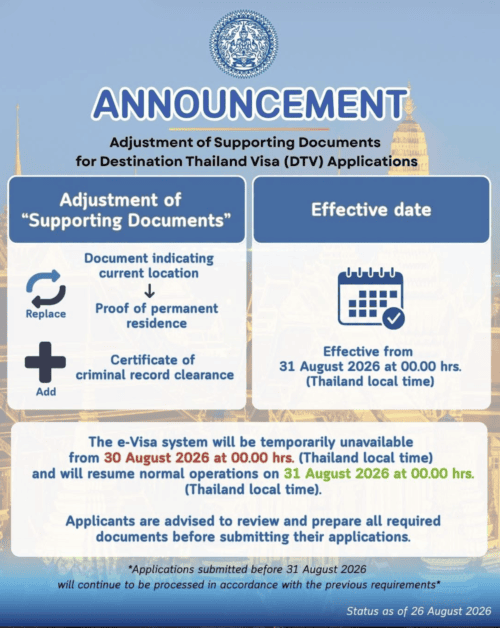
Thailand DTV visa rules 2026 tightened from August 31 — DTV applications now restricted to the applicant's country of citizenship or permanent residency, closing the popular Vientiane and London embassy application routes, while a Police Clearance Certificate becomes mandatory for all DTV applicants including Indian nationals.
Quick answer: From August 31, 2026, Thailand’s Digital Nomad Visa (DTV) applicants can only apply from their country of citizenship or permanent residency — third-country applications are no longer accepted. A Police Clearance Certificate (PCC) is now mandatory for all DTV applications. Indian applicants get their PCC from the Passport Seva Portal at passportindia.gov.in. Thailand’s current Covid-19 variant (BN.1.8.1) is non-severe — no festival cancellations.
Thailand DTV visa rules 2026 changed significantly from August 31 — the Digital Nomad Visa application window has been tightened in two critical ways that every Indian applicant must understand before booking flights or making any Thailand long-stay plans.
The Thailand DTV visa rules 2026 changes affect Indian digital nomads, remote workers, and long-stay travelers who were previously able to apply for the DTV from any Thai embassy globally — including popular applicant locations like Bangkok (for those already in Thailand), Vientiane (Laos), London, or Dhaka. That flexibility ends August 31. Going forward, DTV applications are generally only accepted at Thai embassies in the applicant’s country of citizenship or permanent residency.
For Indian applicants, this means the Royal Thai Embassy in New Delhi or Thai Consulates in Mumbai, Chennai, Bengaluru, or Kolkata — not the Royal Thai Embassy in London, Vientiane, Dhaka, or anywhere else unless India is not your country of citizenship. See our Thailand deportation rules 2026 guide for the full August 2026 Thailand regulatory context.
The Two DTV Rule Changes From August 31
Change 1 — Home country applications only.
From August 31, DTV applicants will generally only be able to apply in a country where they are a citizen or permanent resident.
The embassies most commonly used by Indian digital nomads for DTV applications from third countries — the Royal Thai Embassy in Vientiane (Laos), the Royal Thai Embassy in London, and the Royal Thai Embassy in Dhaka — are no longer valid application points for Indian citizens from August 31.
This change closes the popular “Vientiane DTV run” — where Indian travelers already in Thailand or Southeast Asia would cross into Laos to apply for or renew the DTV at the Vientiane embassy rather than travelling back to India. That option ends August 31. Indian DTV applicants must now apply at a Thai embassy in India.
Change 2 — Police Clearance Certificate mandatory.
A Police Clearance Certificate will also become mandatory for all DTV applications from August 31.
The Police Clearance Certificate (PCC) is a document issued by India’s government confirming that the applicant has no criminal record. It is issued by the Passport Seva Kendra network and processed through the Passport Seva Portal at passportindia.gov.in.
How Indian Applicants Get Their PCC: Step-by-Step
The Police Clearance Certificate for your Thailand DTV application is obtained through India’s Passport Seva Portal — the same system used for Indian passport applications. The process takes approximately 3–7 working days from application to delivery.
Step 1 — Register or log in. Go to passportindia.gov.in and create a new user account or log in with your existing credentials. The portal requires your email address and mobile number for OTP verification.
Step 2 — Submit the PCC application form. Click the link to Apply for Police Clearance Certificate. Complete the required applicant details (name, DOB, passport number), family details, and current address details, then submit the form.
Step 3 — Pay the fee and schedule your appointment. Go to View Saved/Submitted Applications, choose Pay and Schedule Appointment, pay the PCC fee online (currently ₹500 for standard processing), and book a slot at your nearest Passport Seva Kendra (PSK) or Regional Passport Office (RPO).
Step 4 — Print your application receipt. Save and print the application receipt containing your Application Reference Number (ARN). This ARN is required at your PSK appointment.
Step 5 — Visit the PSK or RPO. Visit the designated centre on your appointment date carrying your printed ARN receipt, original passport, and supporting documents (typically address proof and any prior criminal court documents if applicable). The appointment takes approximately 15–20 minutes.
Step 6 — Police verification. Local police authorities will conduct a background check or visit your residential address if required based on your current address records. Standard PCC processing for applicants with no criminal record typically completes in 3–7 working days after the PSK appointment.
| Thailand DTV Visa Rules 2026 — PCC Application Summary | Detail |
|---|---|
| Portal | passportindia.gov.in |
| Document name | Police Clearance Certificate (PCC) |
| Fee | ₹500 (standard processing) |
| Processing time | 3–7 working days |
| Appointment required | Yes — Passport Seva Kendra or RPO |
| Documents needed | ARN receipt, original passport, address proof |
| Police verification | May include home visit based on current address |
| Valid for DTV application | Present at Thai embassy alongside DTV documents |
Where Indian Citizens Can Apply for the DTV
From August 31, Indian citizens can apply for the Thailand DTV only at the following locations in India:
Royal Thai Embassy — New Delhi (Primary application centre for most Indian applicants)
Shanti Path, Chanakyapuri, New Delhi – 110021
Royal Thai Consulate-General — Mumbai
Handles applicants from Maharashtra, Goa, Madhya Pradesh, and Gujarat
Royal Thai Consulate-General — Bengaluru
Handles applicants from Karnataka, Andhra Pradesh, and Telangana
Royal Thai Consulate-General — Chennai
Handles applicants from Tamil Nadu and Kerala
Royal Thai Consulate-General — Kolkata
Handles applicants from West Bengal, Northeast India, Odisha, and Bihar
Confirm exact jurisdiction with the relevant Thai diplomatic mission before submitting — jurisdictions can change and some states may have updated coverage arrangements.
Thailand Covid-19 Update: BN.1.8.1 Is Dominant, No Festival Cancellations
Alongside the DTV rule changes, two Covid-19 related advisories are circulating for Thailand that Indian travelers planning trips should be aware of.
The actual situation. The BN.1.8.1 variant is the dominant Covid-19 strain driving a recent surge in infections in Thailand. This variant was responsible for 65.2% of cases collected from 84 samples between June 19 and July 20, 2026. Health officials confirmed NB.1.8.1 is Thailand’s main monitored variant, with no evidence of greater severity and no need to cancel festivals or events.
The viral misinformation. Thailand’s Department of Disease Control has rejected a recycled online warning claiming that New Year celebrations will be cancelled because of an outbreak of a Covid-19 variant described as “Deltacron XBC.” This warning is false. The DDC confirmed it is a recycled online rumour — the Deltacron XBC strain referenced in the warning does not exist as a distinct identified variant, and no Thai New Year or festival cancellations have been announced or are planned.
What this means for Indian travelers. Thailand does not currently require Covid-19 vaccination certificates or testing for Indian visitors. The BN.1.8.1 variant surge does not trigger any Thailand entry restriction for Indian passport holders. Standard health precautions — masks in crowded indoor settings if you prefer, hand hygiene — are sensible but not mandatory. The viral festival cancellation warning is misinformation — do not adjust your Thailand travel plans based on it.
Tourist Police Safety Updates
The Tourism Authority of Thailand highlighted that safety is at the heart of every great travel experience through a close partnership with the Tourist Police Bureau that is building a more secure environment for visitors across Thailand.
The latest Tourist Police Bureau upgrades include inspection of mobile UAV (drone) command units for enhanced surveillance, review of specialized safety equipment and technology upgrades, deployment of tourist police officers dedicated to visitor safety, and stronger coordination between tourism and security agencies.
The drone surveillance deployment is the most operationally significant element — UAV command units provide aerial situational awareness at major tourist concentrations, events, and beach destinations that ground patrols cannot match in coverage area. For Indian travelers at crowded Bangkok attractions, Phuket beaches, or Chiang Mai markets, enhanced aerial surveillance is a genuine security infrastructure upgrade.
The Tourist Police Bureau hotline for Indian travelers in Thailand is 1155 — available 24 hours, multilingual assistance, reachable from any Thai phone including SIM cards purchased at airports.
What Indian Travelers With DTV Plans Must Do Now
The Thailand DTV visa rules 2026 changes require specific immediate action for Indian nationals who were planning to apply for or renew a DTV from a third country.
If you planned to apply from Vientiane, London, or Dhaka: Those options end August 31. Return to India and apply from the relevant Thai embassy or consulate in your home state’s jurisdiction. Contact your specific Thai diplomatic mission before visiting to confirm current DTV requirements including the mandatory PCC.
Start your PCC application immediately. The PCC process takes 3–7 working days minimum — potentially longer during high-demand periods or if police verification requires a home visit. Apply for your PCC at passportindia.gov.in before applying for your DTV appointment. You need the PCC in hand before your Thai embassy DTV appointment.
Check the full DTV requirements. Beyond the new PCC requirement, the standard DTV documentation includes proof of remote work or freelance income, bank statements, health insurance coverage, and a completed DTV application form. Contact your relevant Thai embassy for the current complete documents checklist — requirements may have been updated alongside the August 31 rule change.
Before any Thailand trip, confirm entry requirements at thaievisa.go.th. Complete the mandatory TDAC free at tdac.immigration.go.th within 72 hours before departure. UPI does not work in Thailand — carry Thai Baht. For travel insurance covering Thailand long-stay and DTV trips, SafetyWing Nomad Insurance provides comprehensive coverage at affordable daily rates for Indian travelers — and is accepted as health insurance documentation for DTV applications.
For a ready-to-use DTV cover letter and supporting document templates, visit travelmantoday.com/visa-templates/.
FAQs — Thailand DTV Visa Rules 2026
Q: What changed about Thailand’s DTV from August 31, 2026?
From August 31, DTV applicants will generally only be able to apply in a country where they are a citizen or permanent resident, and a police clearance certificate will also become mandatory. For Indian applicants, this means DTV applications must be submitted at a Thai embassy or consulate in India — not at the Royal Thai Embassy in Vientiane, London, Dhaka, or any other third-country location. The Police Clearance Certificate required is obtained through India’s Passport Seva Portal at passportindia.gov.in.
Q: How do Indian citizens get a Police Clearance Certificate for Thailand DTV?
Apply through passportindia.gov.in — log in, click Apply for Police Clearance Certificate, complete the applicant, family, and address details, pay the fee online (₹500), and schedule an appointment at your nearest Passport Seva Kendra or Regional Passport Office. Visit the PSK with your printed ARN receipt, original passport, and supporting documents. Local police will conduct a background check or visit your residential address if required. Standard processing takes 3–7 working days from the PSK appointment date.
Q: Is the Covid-19 BN.1.8.1 variant in Thailand a reason to cancel travel?
No — health officials confirmed NB.1.8.1 is Thailand’s main monitored variant, with no evidence of greater severity and no need to cancel festivals. Thailand does not require Covid-19 vaccination or testing for Indian passport holders. The viral warning about “Deltacron XBC” causing New Year festival cancellations is misinformation — Thailand’s Department of Disease Control rejected this claim. No festival cancellations have been announced. Standard health precautions are sensible but Thai entry requirements for Indian travelers are unchanged.
Final Word
The Thailand DTV visa rules 2026 changes from August 31 — home country applications only, mandatory Police Clearance Certificate — represent the most significant tightening of the DTV framework since the visa was introduced.
Indian digital nomads and long-stay travelers planning a DTV application need to act now: obtain your PCC through passportindia.gov.in, schedule your Thai embassy appointment in India, and do not plan to apply from Vientiane, London, or Dhaka.
The DTV remains a genuinely excellent visa for Indian remote workers who want extended Thailand access — the August 31 changes make the application process stricter but the underlying visa product unchanged.
Also Read:
- Thailand Deportation Rules 2026 — New Law Active August 28
- Thailand Travel Update Indians — August 2026 Five Changes
- Thailand Alcohol Rules 2026 — BMA Cracks Down, Hours Guide
Official Sources:
 Singapore Tourism Receipts 2026: S$7.21 Billion Drop — What It Means for Indians
Bangkok Flooding October 2026: Roads Submerged — What Indians Must Know
Laem Son National Park 2026: Thailand’s Hidden Beach Gem Opens for Tourism Season
Japan Saudi Arabia Travel Alert 2026: Essential Warning for Indians Visiting the Kingdom
Singapore Tourism Receipts 2026: S$7.21 Billion Drop — What It Means for Indians
Bangkok Flooding October 2026: Roads Submerged — What Indians Must Know
Laem Son National Park 2026: Thailand’s Hidden Beach Gem Opens for Tourism Season
Japan Saudi Arabia Travel Alert 2026: Essential Warning for Indians Visiting the Kingdom

Aaseem Bhardwaj is a journalist, seasoned traveler and IT professional based in India. With firsthand travel experience across Southeast Asia, East Asia, Middle East and Europe, Aaseem founded Travel Man Today to provide reliable visa updates and travel news for Indian passport holders. He has personally traveled to Thailand, Vietnam, Malaysia, Japan, Singapore, Hong Kong, South Korea, UAE and Europe. Follow his travel vlogs on YouTube at @travelmantoday



Templates for Indians


2 thoughts on “Thailand DTV Visa Rules 2026: Home Country Only from August 31, PCC Now Mandatory”